Making a project fundable is a discipline. South Africa is short of it.
Government has just put its finger on the most important word in South African infrastructure, and most of the coverage skated straight past it.
At the end of July, Infrastructure South Africa opened its third project preparation bid window, with R600 million committed to help public-sector projects become, in the official language, "bankable, investment-ready projects." Qualifying projects need a capital value of R1 billion or more, and have to show they can pull in funding from development finance institutions, multilateral banks and private investors.
The department was honest about why this is needed. As the Minister put it, projects fail "not because the need does not exist, but because the preparation work is weak. Feasibility studies are incomplete. Approvals are delayed. Funding models are unclear. Project packaging is poor. And promising ideas never become construction sites."
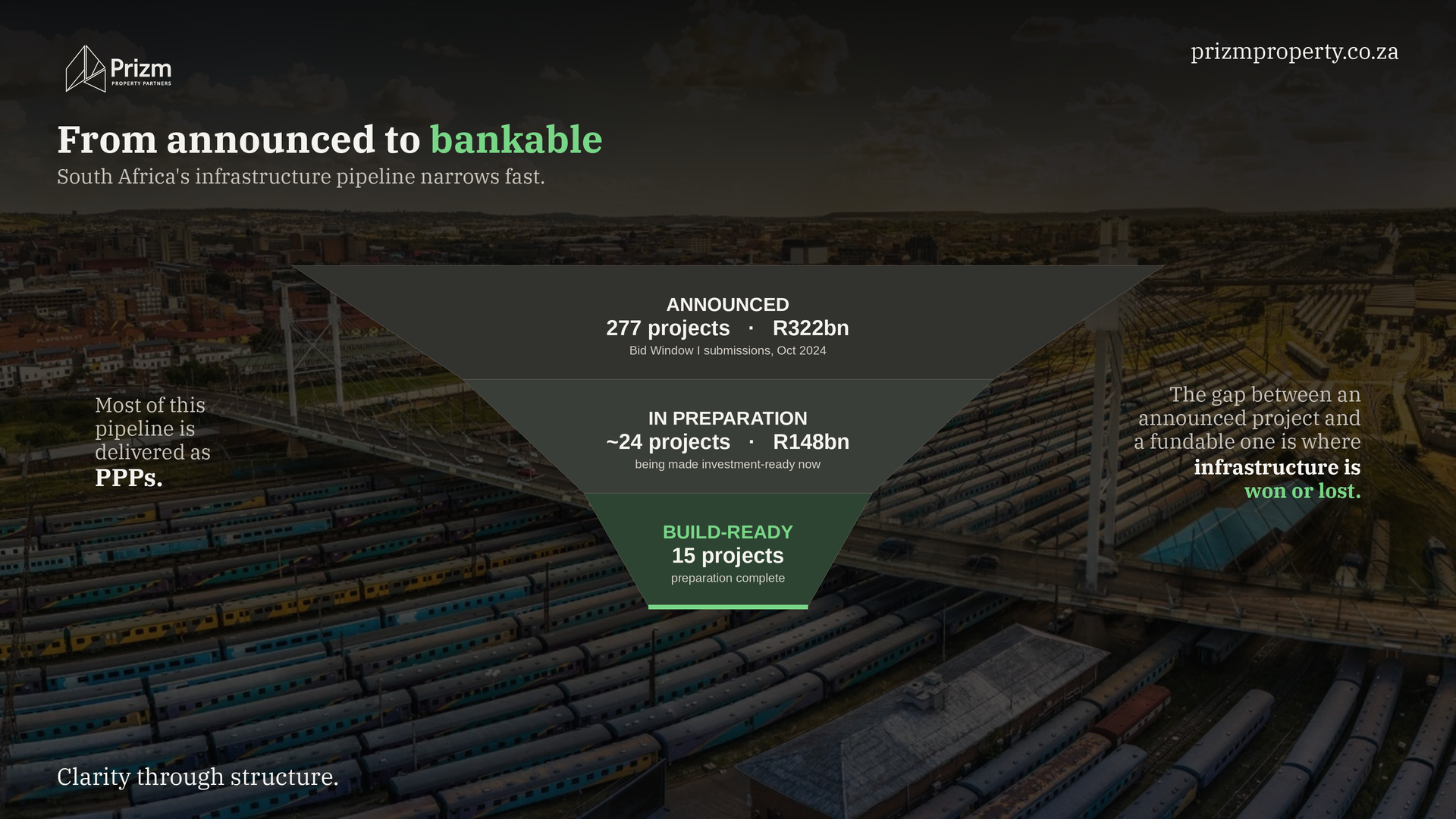
That's exactly right. And the numbers behind it tell the story better than the announcement does. The first bid window, back in October 2024, drew 277 submissions worth a combined R322 billion. Today, Infrastructure SA is actively preparing around 24 of them, worth about R148 billion, and only 15 projects have finished their preparation work. Just last week the department went to market looking for R53 billion in debt to get four projects — housing, aviation, water, energy — off the ground. Read those numbers in sequence and the picture is plain: the demand to get projects ready vastly outruns the capacity to do it.
Everything turns on that one word — "bankable" — and the gap between an announced project and a bankable one is far wider than most people outside the funding room realise.
What a funder actually means by bankable
When a bank or a DFI calls a project bankable, they don't mean it's a good idea. Almost every announced project is a good idea. They mean something narrower and much harder: that it's been structured so a lender can see, with acceptable certainty, how they get their money back.
That's a high bar, and it has almost nothing to do with the vision and almost everything to do with the structure underneath it. A few of the things that live inside "bankable," none of which show up in an announcement:
- The revenue has to be real. Contracted, or underpinned by something a lender can actually rely on. Who pays, how much, for how long, and what happens if they don't. A road or a water scheme without a clear, durable payment mechanism isn't bankable no matter how badly it's needed.
- The risk has to sit in the right place. Construction risk, demand risk, currency risk, the risk a counterparty doesn't pay. Each one has to be identified and handed to whoever is best placed to carry it, and priced. A project where all the risk lands on the lender isn't a deal, it's a hope.
- The approvals and the land have to be there. Not "in progress." The environmental authorisation, the servitudes, the licences, the land assembly — the things that quietly kill projects between announcement and delivery. A funder reads an unresolved approval as an unpriced risk, and unpriced risk means no money.
- The rights have to transfer cleanly. The one most people miss. A project is only fundable if the rights and obligations it rests on can move cleanly to the entity that owns it and the lenders securing against it. Where that transfer is uncertain, the whole thing wobbles.
- And the funding model has to hold together. The Minister named this one directly. The capital has to be stacked so the numbers work at every level — the blend of grant, concessional, DFI and commercial money, the order it draws and repays in, the cover a lender needs to feel safe. This is slow, unglamorous, iterative work, and it's where a lot of projects quietly come apart.
None of that is visible when a project is announced. All of it is what "bankable" means. It's a specialised discipline in its own right — the difference between a presentation and a project.
Most of these will be public-private partnerships
It's worth being clear about how these projects actually get built, because it shapes everything about what "bankable" demands. Most of this pipeline will be delivered as public-private partnerships. Treasury has said as much, and there are dozens of them moving through inception, feasibility and procurement right now.
A PPP raises the bar rather than lowering it. A private party designs, builds, finances and operates the asset, and gets paid back over a long contract — by government through availability payments, by users through tariffs, or some mix of the two. For that to work, the private party and its lenders have to believe in a revenue stream stretching fifteen or twenty years out before they'll put money in today. Everything hard about bankability is concentrated right there.
South Africa has just rebuilt the rules for this. Treasury Regulation 16, the framework governing PPPs, has been reformed to make them faster and more practical without giving up fiscal discipline. Projects under R2 billion now follow a shorter approval path, a dedicated PPP Advisory Unit has been set up as the state's centre of structuring expertise, and — importantly — a losing bidder can now recover part of its preparation costs. That last one is a quiet admission that doing this work properly is expensive, and that we need far more of it done.
Underneath all of it sit three tests every PPP has to pass: affordability, value for money, and substantial risk transfer. Read those against the funder's checklist above and they're the same thing in formal dress. Affordability is whether the revenue genuinely covers the obligation over the full term. Value for money is not the cheapest bid; it's whether the structure delivers better risk-adjusted value than government just building the thing itself, which is exactly why real risk transfer sits at the heart of it. And risk transfer is the discipline of moving each risk to whoever can best carry it.
That's the real work of a PPP, and it's worth being honest about what it involves: you're balancing two sets of interests at once. The public side needs affordability, value for money and genuine risk transfer. The private side needs a return it can bank and a risk it can price. A structure only works when it satisfies both — when the same deal is fundable to a lender and defensible to Treasury. Get the balance wrong in either direction and the project doesn't happen. The regulations are, in effect, an attempt to legislate that balance. That tells you how central it is, and how hard.
Why this is the real constraint
Here's the part worth sitting with. South Africa doesn't have an ambition problem. The pipeline of ideas is enormous — hundreds of projects across housing, energy, water and transport. What it has is a preparation problem, and preparation is just the work of turning a good idea into a bankable one.
Which is why R600 million matters more than its size suggests. Preparation money is high-leverage: a relatively small spend making a project genuinely investment-ready can unlock many multiples of that in real financing, because it turns something no funder can touch into something a funder can price. The state blending its own seed money with other facilities, including a joint one with Afreximbank, tells you it has worked out that preparation is the bottleneck — not capital. The capital is there, at home and abroad, waiting for projects it can actually fund.
The uncomfortable part is what that implies. The binding constraint on South African infrastructure has never really been money, or even ideas. It's the patient, structural work of making a project fundable — the work between the announcement and the shovel. The least visible part of the whole process, and by some distance the most decisive.
The point for anyone who builds, funds or governs
For government, the lesson sits inside its own programme: preparation isn't a box to tick on the way to construction. It's the step that decides whether construction ever happens. Funding it properly is one of the highest-return things the state can do.
For the private sector, the opportunity is in exactly the gap the Minister described. The ability to take a project from concept to genuinely bankable — to structure the revenue, place the risk, resolve the approvals, build the funding model — is scarce and valuable, and it's precisely what stands between the country's enormous pipeline of ideas and its much smaller pipeline of things actually being built.
And for everyone else watching announcements go by, the useful filter is simple. When the next R1 billion project gets unveiled, the question that matters isn't whether it's a good idea. It's whether anyone has done the quiet, difficult work of making it bankable. Because that word is where South African infrastructure is won or lost.