The real divide in South African property isn't residential versus commercial. It's the capital stack.
There is a lazy way to sort South African property firms: residential on one side, commercial on the other. Houses and flats and student rooms over here; offices, malls and warehouses over there. It is tidy, and it is almost irrelevant for understanding how these businesses actually work.
The real divide is not what the firms own. It is how they fund what they own, and once you look at the capital structure rather than the building, the neat categories fall apart in an interesting way.
The myth of the two worlds
The perceived picture is that residential rental — especially affordable and student housing — is the domain of social capital, and commercial is the domain of profit capital. Development finance institutions, impact funds and government-backed vehicles fund the former at soft rates because they care about outcomes; hard-nosed institutional money funds the latter because it wants returns.
The people actually doing the deals will tell you this is wrong. The affordable-housing funders are blunt that their investors expect real returns, often on par with commercial. One impact fund put it plainly: this is not concessionary capital, it is a commercial return that happens to solve a national problem. Track records back that up — exited affordable-housing portfolios in this market have posted internal rates of return well around the 20% mark. Nobody in residential is apologising for making money.
So if it isn't profit versus charity, what is the difference?
It helps to note why blended capital has become more central, not less. Government debt has climbed from roughly 44% of GDP in 2000 to nearly 80% today. A state that stretched cannot fund social outcomes directly off its own balance sheet, so it increasingly does so indirectly — anchoring first-loss tranches and concessional lines that pull private capital into housing and social infrastructure it can no longer build alone. The blended structure is, in part, a fiscal workaround.
It's the shape of the stack
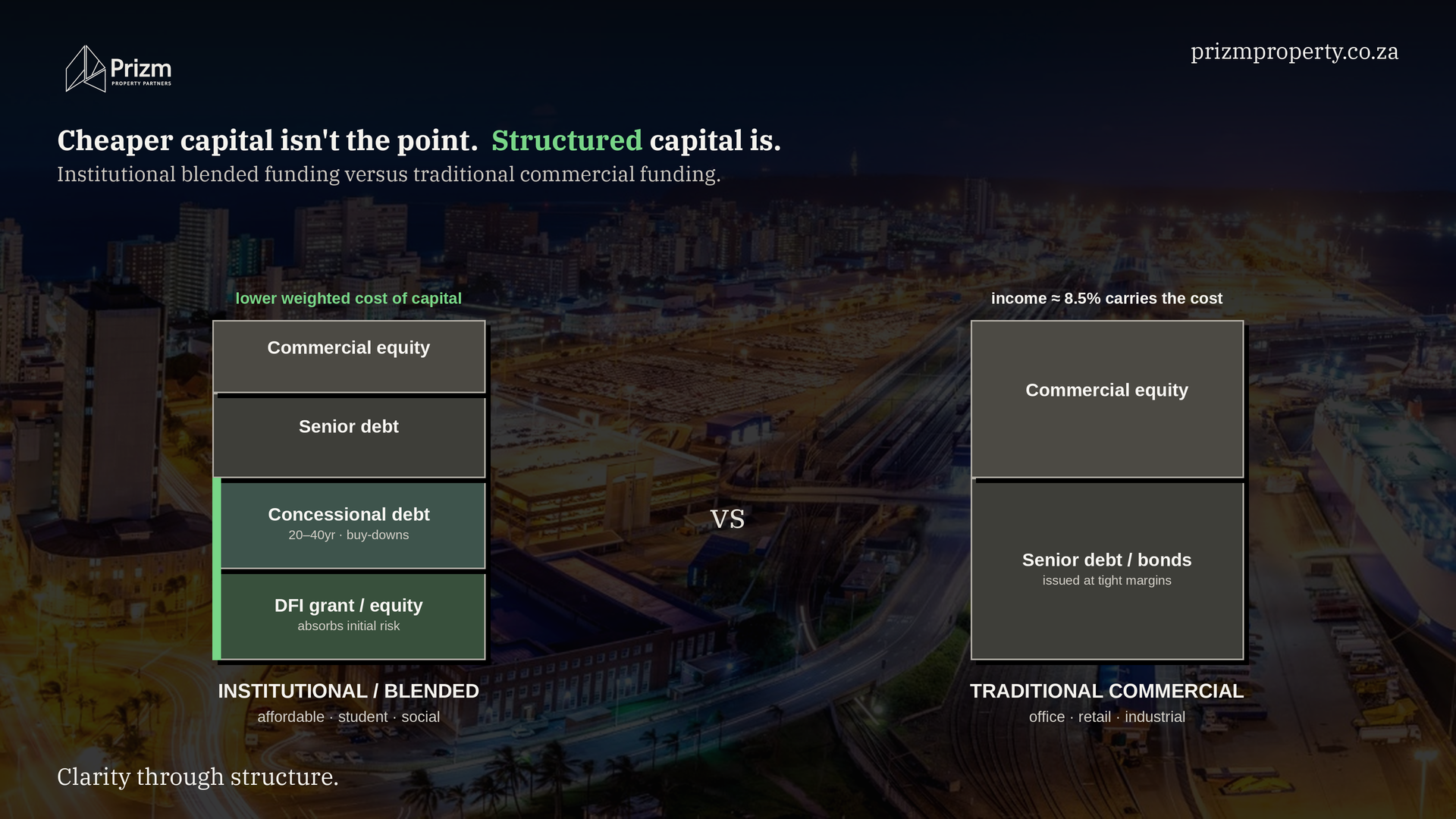
The difference is in how the capital is assembled. Residential-led firms, particularly in the affordable and student space, are built to construct blended structures: a grant tranche at the bottom, anchored by public or DFI money, which absorbs the initial risk; concessional long-tenor debt in the middle, with long-term amortisation, construction grace periods and interest-rate buy-downs; and commercial equity and senior debt on top. The first-loss layer is the trick. It lowers the weighted cost of capital for everyone above it, which is what makes thin-margin affordable rental bankable at all.
To see why that engineering is necessary, look at the cost of straight debt. With prime around 10.5% and inflation in the mid-single digits, the real cost of ordinary commercial debt has recently sat in the region of 5% to 7% — elevated by any historical standard, and brutal for any asset with a thin income yield. This is the number that forces the split. An asset throwing off a high, stable income can absorb a real debt cost of that order. An affordable-rental asset with a compressed margin cannot — not on a straight stack. The blended structure isn't ideology; it's the only arithmetic that clears.
That is also why the return profiles matter more than the headline totals. On the index data for 2025, commercial property delivered a total return of about 12%, of which roughly 8.5% was income and only about 3.5% was capital growth. Residential, by contrast, returned closer to 6% in total — less than half of commercial's return, and off a much thinner income yield. Over ten years the pattern is the same: commercial's return is income-led, at roughly 7.6% income against 2.8% capital annualised. Residential is the sector with the thinnest income yield and the lowest total return — which is precisely the wrong profile to carry an expensive straight debt stack, and precisely why it needs the blended one.
Commercial-led firms don't need that machinery for their core stock. A strong commercial private entity or listed REIT funds itself with straight equity and bonds at keen rates. In the current market the better-rated names are issuing bonds at tight margins and running conservative loan-to-value ratios comfortably. When your asset earns around 8.5% income against a real debt cost in that range, you don't go looking for a grant tranche.
These are genuinely different financial-engineering skills. Assembling a blended structure — negotiating with a DFI, sizing a first-loss layer, structuring a buy-down — has almost nothing in common with pricing a straight corporate bond. That, more than the bricks, is why the two kinds of firm have historically not been the same firm.
The line is dissolving — from the commercial side
Here is the part the tidy categories miss entirely. The commercial giants have learned to run both structures at once.
Look at what the large diversified REITs actually do now. They take development-finance money — green bonds placed with DFIs, blended packages for specific verticals — where it suits them. They spin up separate specialist vehicles for social-led developments, structured as their own funds so they can attract third-party and DFI capital that would never come onto a diversified balance sheet. They hold a minority stake in each and earn management fees on the rest. The generalist has become, quietly, a manager of specialist blended structures.
Read that carefully, because it is the whole point. These firms are not buying residential buildings and bolting them on. They are building bespoke capital structures around specific asset classes, and increasingly acting as the manager of those structures rather than the owner. The blended-capital skill that used to define the residential specialist is being absorbed by the commercial house — not to be nice, but because it opens deals a straight commercial cost of capital cannot reach.
What this means for how you read a firm
The useful question about a South African property business is no longer "residential or commercial?" It is "what capital can this firm assemble, and for which assets?" A firm that can only raise straight commercial money is confined to assets that clear a commercial hurdle. A firm that can build a blended stack can reach into affordable housing, student accommodation and social infrastructure where the commercial-only players simply cannot follow — and can do it while still paying its investors a real return.
The firms that will matter over the next decade are not the ones that pick residential or commercial. They are the ones that treat capital structure as the product — matching the right stack to the right asset, and charging for the skill of doing it. The building is almost incidental. The structure is the business.