Credit applications that get approved answer the questions before they are asked.
Every lender has thresholds, and they are not printed on the application form. Debt service cover is tested monthly through the refinance, not annually on averages. Loan-to-value is measured against modelled income, not the purchase price. Stress runs hit exit yield, voids and escalation simultaneously — because that is how trouble actually arrives.
Knowing where those lines sit for that bank, that committee and that asset class is not something an investor learns on the first submission. It is earned one submission at a time, and it compounds across cycles — because the thresholds themselves move when rates and credit appetite do.
Credibility at the credit table cannot be bought. It is earned the moment the committee sees a pack that weighs risk as seriously as return. Lead with the upside and bury the downside, and the analyst will run the downside for you — on harsher assumptions, on their timeline. Name your risks, quantify them, and show the headroom that survives them, and the analyst becomes your advocate inside the committee, on your numbers.
Here is what that is worth in rand terms. A submission that misses the thresholds does not get declined — it gets queried. Three weeks per round, four or five rounds, and a R150 million acquisition is now four months old. The escalation clause has ticked. Guarantee and commitment fees have run.
The equity is committed but earning nothing. The seller and the rate cycle have both had a hundred days to change their minds. None of that friction improves the deal. All of it is priced into the sponsor's outcome.
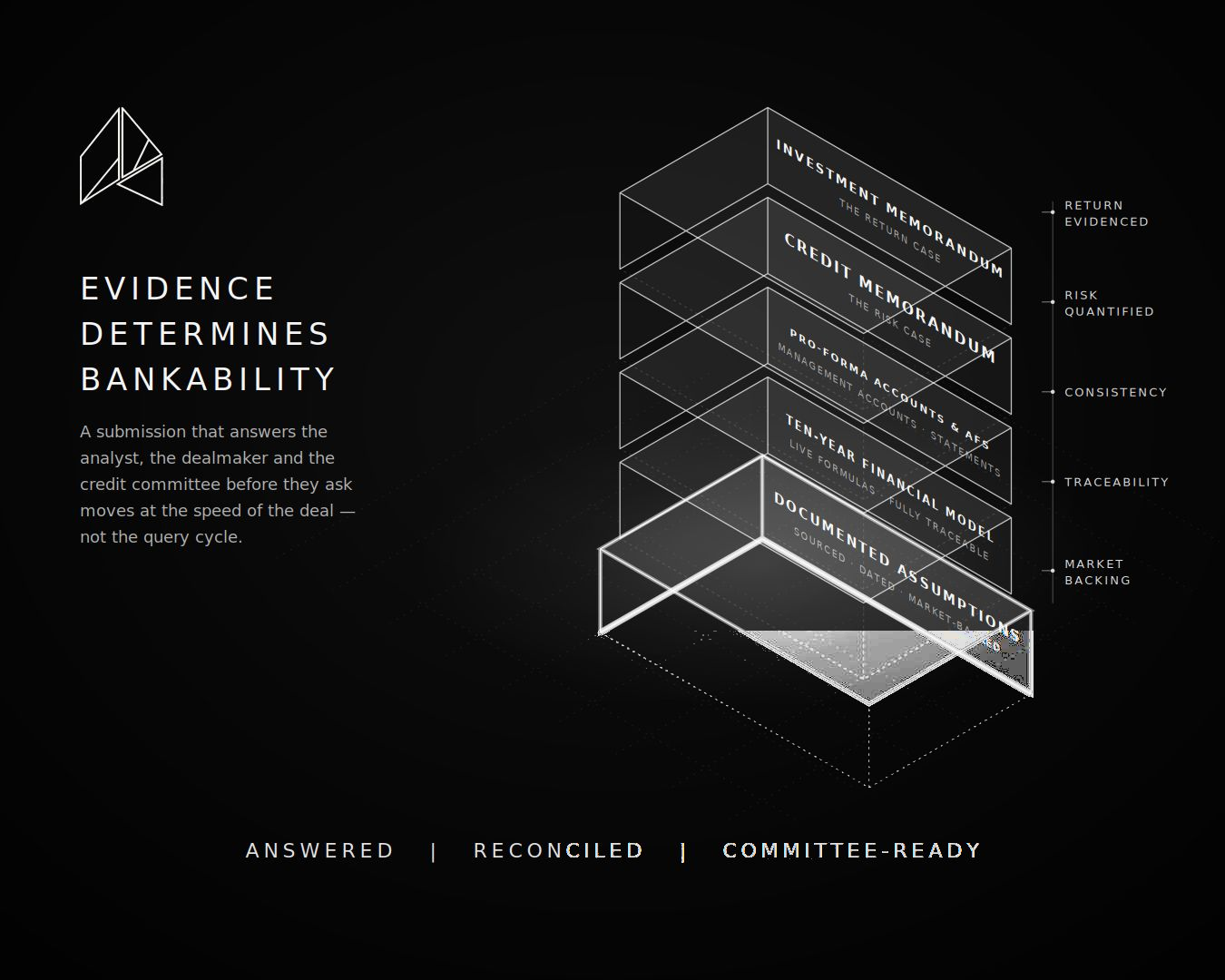
Against that stands a once-off cost: a properly built pack — live model, documented assumptions, pro-forma accounts, investment and credit memoranda — curated by someone who already knows what the committee will test. It answers the four rounds of queries before they are asked.
In South Africa, where every rand of capital carries an emerging-market premium, this is not gold-plating. It is the standard development finance institutions already enforce, and commercial banks apply the same logic whether the form admits it or not.
The arithmetic for sponsors in the R50–300+ million range is not close. The pack costs a fraction of what the friction does — the difference is that the pack is invoiced once, and the friction compounds quietly until the deal dies of old age.