Durban's Point Waterfront hasn't failed because of anything on the ground.
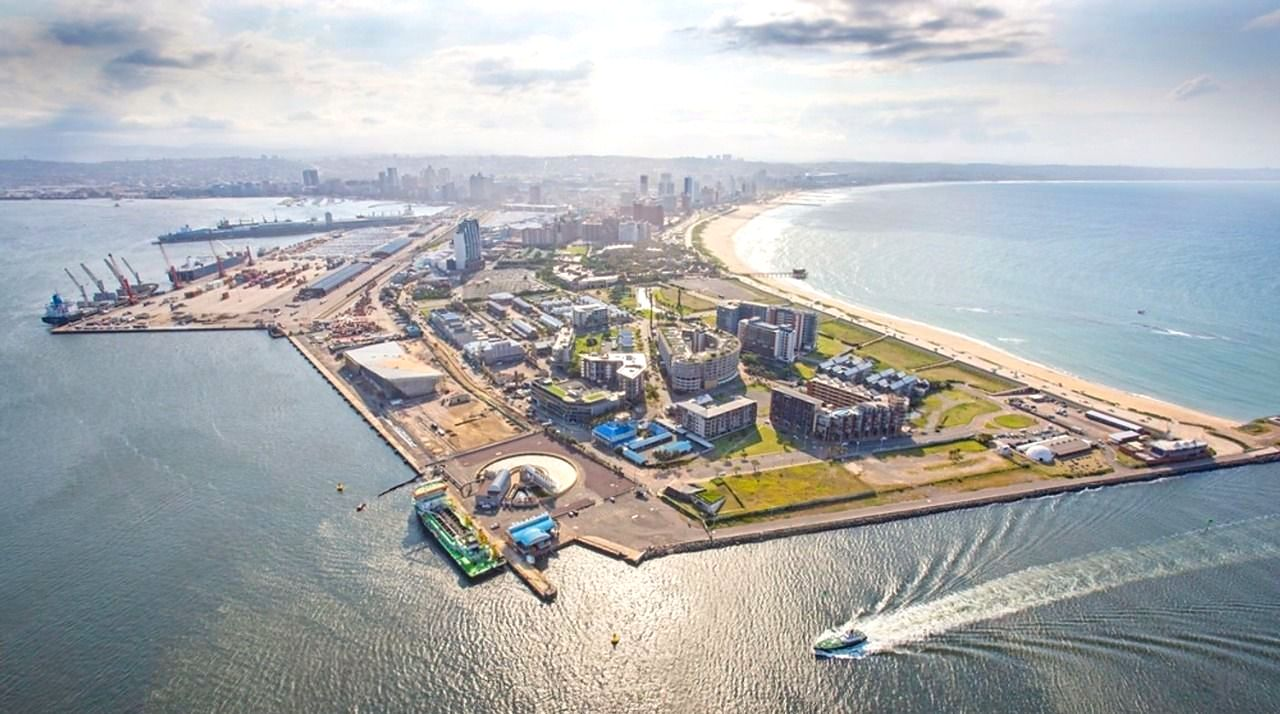
Everyone has looked at Durban's Point Waterfront — the standard read is a great site that keeps failing. That's half right: it is a great site, but it hasn't failed because of anything on the ground.
Fifty-five hectares at the mouth of the continent's busiest port, with 360-degree water frontage — ocean beach on one side, harbour and working bay on the other. No second site like it in the country: Cape Town's V&A has the dock and the bay, not the beach.
Approved bulk of 750,000m². Roads, water, power in. A promenade that opened in 2019, a cruise terminal built in 2023 drawing c.255,000 passengers in 2026. The World Bank ranked Durban the world's most improved port of 2025. Serviced bulk, approved rights, a completed public realm, on the rarest waterfront landholding in South Africa — on paper, one of the most investable propositions on the continent.
So why is most of it still empty? Look at the record rather than the renders, and the same failure repeats — and it's never the site.
Four cycles, one pattern
In 1859 the Colony approved a harbour-mouth scheme designed by an engineer in London who never visited Durban. By 1864, 70% of the budget was gone on works a fifth complete, and it was abandoned. What survives is Vetch's Pier, now a dive reef.
A Malaysian tender in the 1990s stalled for six years, not on planning or demand, but on who the partners would be. The 2008 build-out was stopped by the financial crisis. The relaunch since 2017 has delivered public infrastructure — while the private pipeline hasn't turned a sod.
Four cycles, one pattern. Each time the land was excellent, the rights obtainable, and delivery stalled on capital, counterparty or governance. Never a site problem — a structure problem, four times running.
The public side keeps delivering. The private capital is the gap.
So the demand is there, and the public sector keeps answering it. The city built the promenade and the terminal, is spending over R230m on Point water infrastructure, and is currently renovating 80% of the corridor's problem buildings — clearing the degraded approach that is the obvious objection. Every part the public side controls, it is delivering on. The one part missing is the private capital to build the waterfront itself.
The vehicle that has held the mandate for two decades is under review, and the second phase reshaped — reopening the only question that governs the outcome: not what gets built, but who is contracted to deliver it, and what happens when they don't.
A site this size doesn't need one master developer carrying R35bn of intent. It needs parcel-level obligations, milestones with teeth, and reversion when a party underperforms — the structuring problem the last four cycles never addressed.
The bones have been at the harbour mouth for 150 years. The next party there doesn't need a better render — it needs a better contract.