Leasehold is bankable — if structured correctly.
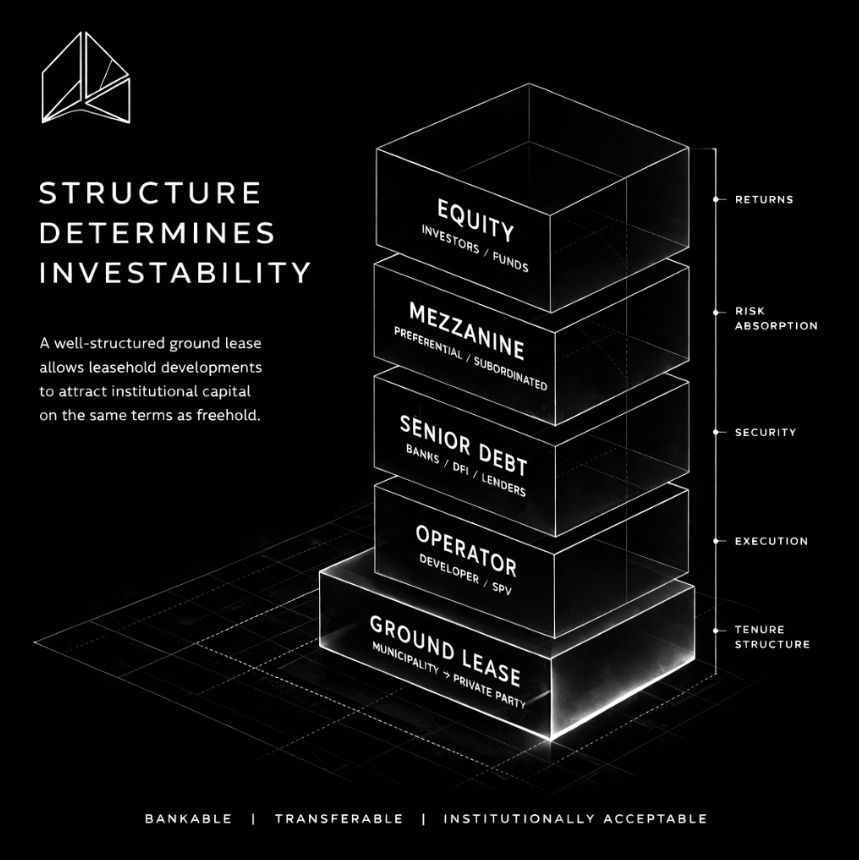
The most common objection to municipal leasehold development is that institutions won't touch it. Banks won't lend. Funds won't hold it. Tenure uncertain, municipality an unreliable counterparty, exit too complicated.
Some of that is fair. Most reflects poorly structured leases rather than any inherent flaw in the instrument.
Ground leasehold is one of the oldest tenure structures in the world. Singapore built an entire property market on 99-year state leases. Amsterdam's municipal land bank has operated on leasehold since 1896. Canberra's land supply is entirely leasehold. Hong Kong — one of the most expensive markets on earth — operates almost entirely on government leases. In each case the instrument works not because leasehold is superior to freehold, but because the terms behave like freehold from a lender and investor perspective.
The terms are everything.
A well-structured ground lease — long initial term with renewal rights, formula-based rent reviews, step-in rights for lenders, clear consent-to-assign provisions, and a termination regime protecting the leasehold interest — is bankable, transferable and institutionally acceptable. It can be mortgaged, sold, held by a REIT, insurer, pension fund or DFI, and structured to produce a DSCR that satisfies a senior lender as cleanly as freehold.
South Africa has not struggled with leasehold because the instrument doesn't work. It has struggled because municipalities have offered leases with short terms, unilateral review rights, limited lender protections, and consent requirements that create exit risk. The instrument has been blamed for the structure's shortcomings.
Municipalities — particularly eThekwini, managing one of the largest municipal land portfolios in the country — are beginning to recognise that lease quality determines development quality. A lease banks won't lend against produces a developer who can't raise capital. A lease institutions won't hold produces a development that can't attract equity.
Structure well and you attract mixed-income, institutionally funded development. Structure poorly and you attract undercapitalised operators focused on short-term extraction.
Municipal portfolios across Johannesburg, Cape Town, eThekwini and Tshwane contain well-located, transit-adjacent sites zoned for exactly what the market needs. The state cannot fund these from its own balance sheet.
The question is whether tenure can be structured to allow private capital and DFIs to participate confidently — a solvable problem, and the conversation municipalities, capital providers and property professionals need to be having together.