The lowest interest rate in a generation was not the cheapest money in a generation.
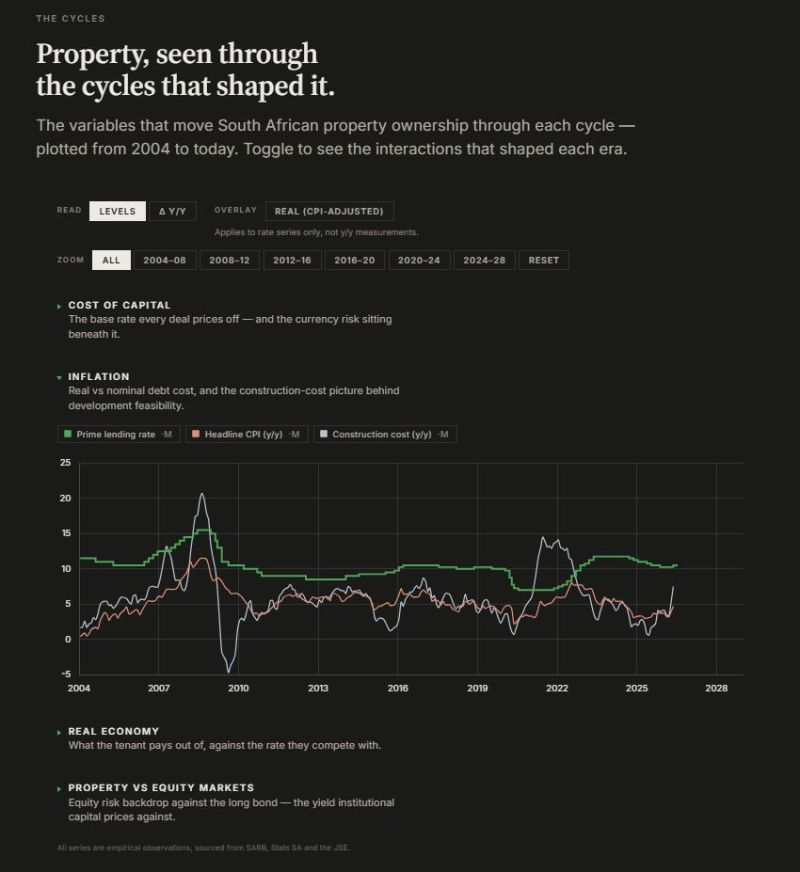
In September 2020, prime sat at 7% — its lowest in decades. With inflation at 3.2%, the real cost of that debt was only 3.8%.
By July 2022, prime had climbed to 9% and was still rising. Debt felt expensive. Yet with inflation at 8%, the real cost of borrowing had dropped to just 1% — the cheapest in the entire period the chart covers.
By February 2026, prime had eased to 10.25% off its recent peak. This felt like relief. But with inflation back at 3.2%, the real cost of debt stood at 7.1% — among the highest in the series.
Three turning points. At each one, the nominal rate and the real cost of borrowing moved in opposite directions. Treating the rate on the term sheet as the rate you are actually paying is one of the most expensive habits in South African property finance.
The figure you subtract also has a composition
The starkest example sits at the start of the series, and it carries a second lesson. In January 2004, prime was 11.5% while headline inflation had collapsed to 0.4% — implying a real cost of debt above 11%, the highest on the chart. But that inflation reading was itself distorted.
The Rand had more than doubled off its 2001 crisis low, crushing imported-goods and fuel inflation; and the headline CPI of that era still included mortgage-bond interest, which the Reserve Bank's own rate cuts had just slashed — mechanically dragging the number toward zero. On the mortgage-stripped measure the Bank actually targeted, inflation was nearer 4%, and the real cost of debt nearer 7 to 8%. Still high — but not 11%.
Even the inflation figure you subtract has a composition you have to know before you trust it.
We plotted the full picture — prime rates, inflation, currency moves, tenant economics and equity conditions from 2004 to today, all sourced to SARB, Stats SA and the JSE. Toggle the real overlay on the rate panel and the divergence becomes obvious.
Which catches more underwriters right now — the 2020 “cheap money” that wasn't, or today's easing cycle that feels cheaper than it actually is?