The Werdmuller isn't waiting for the right developer. It's waiting for the right question.
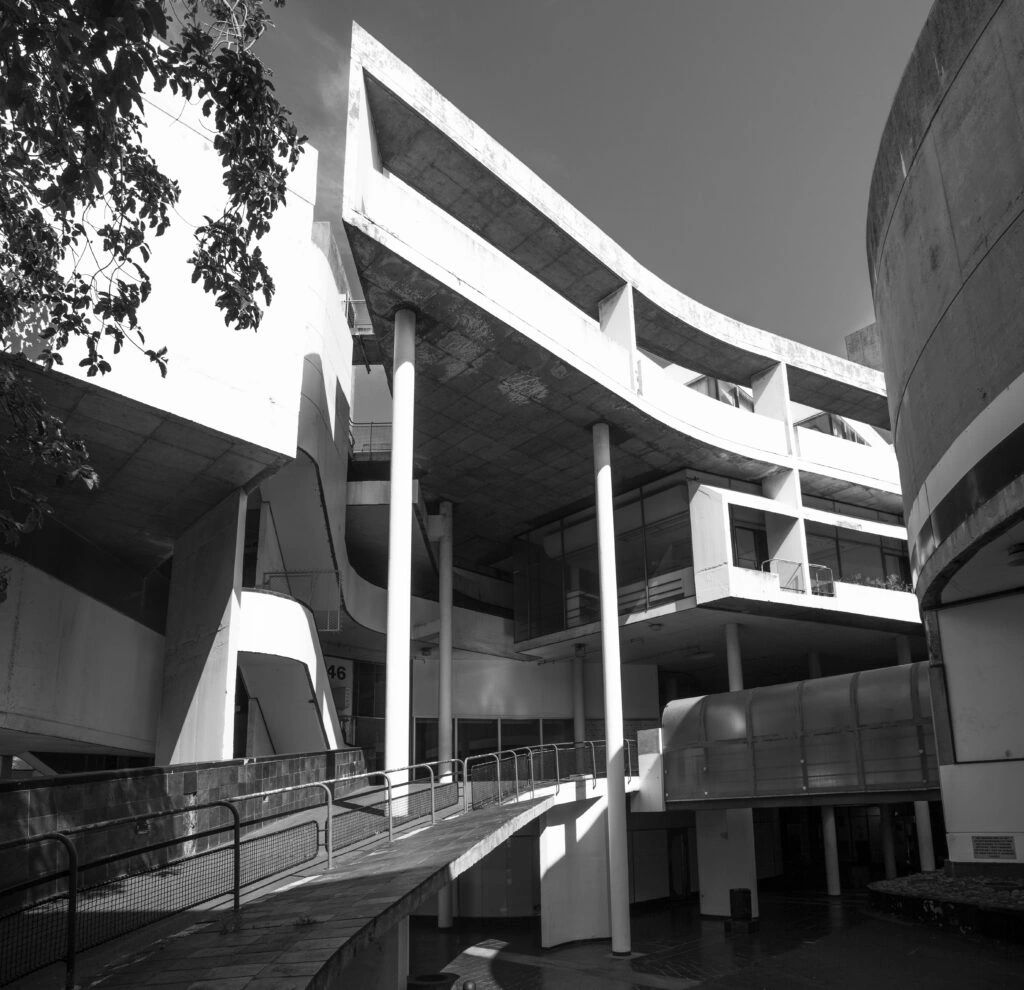
The Werdmuller Centre in Claremont has been empty for over a decade.
Designed by Roelof Uytenbogaardt — voted Architect of the 20th Century in South Africa — it was conceived as a civic market and transit hub serving everyone moving between Claremont Station and Main Road, regardless of income.
It's a piece of modernist architecture compared internationally to Le Corbusier's Carpenter Centre at Harvard. Heritage Western Cape approved partial demolition in 2023 after a four-year process. The replacement scheme still hasn't broken ground.
We've spent the last few weeks doing a feasibility study on it — not starting from what a developer might want to build, but from what the precinct actually needs. Most adaptive-reuse proposals fail at exactly that point: they fit a generic programme into a difficult building rather than asking what uses would make it genuinely irreplaceable.
Our view is that a cultural hub, grounded economically by the thriving student population in the area, is where the answer lies.
But the Werdmuller is a lens for a much larger conversation.
South Africa has 338 hijacked government buildings. Johannesburg alone has an estimated 200 derelict structures in its inner city. Municipalities across the country are auditing their registers — and finding buildings that have been vacant or hijacked for decades.
These aren't marginal sites. Most are well-located, well-connected, and structurally sound — nowhere more so than in our stock of modernist buildings from the 1950s to the 1980s.
Thick concrete, generous floor heights, and large structural bays make these buildings well-suited to residential conversion in a way that later curtain-wall buildings simply aren't. Research in the Journal of Sustainability found adaptive reuse reduces embodied carbon by 50 to 75 percent versus new construction.
Jewel City in Marshalltown shows what's possible: six derelict city blocks converted into 2,700 apartments and 20,000m² of commercial space, now fully let. Durban has several modernist buildings with equivalent potential, still waiting.
Converting them into mixed-income residential with activated ground floors delivers well-located housing, arrests deterioration, and pulls commercial activity back into CBDs that have been hollowing out for many years. Johannesburg, Durban, Pretoria, Gqeberha, Bloemfontein, East London — all have versions of this opportunity sitting largely unaddressed.
The constraint isn't capital. It isn't policy. It is the capacity to ask the right question about what a specific building should become, and to structure the pathways to get it built.
The Werdmuller isn't waiting for the right developer. It's waiting for the right question.